Nvidiaã‚â® Geforceã‚â® Gtx 1080 With 8gb Gddr5x Graphics Memory Review
It's never been a ameliorate time to be a PC gamer. Hardware is getting both cheaper and more powerful, most large-budget console games are making information technology to PCs (where they also look amend), and the rise of virtual reality offers a tempting upgrade target. NVIDIA, i of the pioneering graphics-carte designers, is taking full reward of this revitalized PC gaming market with the GeForce GTX 1080, its latest powerhouse GPU. It'southward the kickoff consumer carte du jour built on the company's Pascal architecture, and, most intriguingly, NVIDIA claims the $599 video card ($699 for the special Founder's Edition) is faster than the Titan Ten, which goes for upwards of $one,000. Subsequently testing it out over the by calendar week, I tin can say the 1080 is clearly something special.
Gallery: GeForce GTX 1080 | 13 Photos
Gallery: GeForce GTX 1080 | 13 Photos


Hardware

I had the privilege of testing the Founder'south Edition of the card, which is something unique for NVIDIA. Previously, the company released fairly plain reference editions of its cards, which would inevitably be one-upped past partners with more-elaborate cooling designs. Simply NVIDIA is positioning the GTX 1080 Founder's Edition as a premium offering. The visitor claims the materials used to build the card, including the aluminum vapor sleeping room cooler (a footstep up from plain-old air cooling) and more-efficient power components, justify its $100 premium. Merely that's a scrap hard to breadbasket when its reference cards had like libation designs in the past.
NVIDIA went for a bit more flair this time around. The sharp angles around the 1080'southward cooler feel more reminiscent of a Ferrari than the visitor's past design. That's a plumbing fixtures mode to represent simply how fast information technology is: It's capable of pumping out nine teraflops of computing power. The 1080 runs at i,607MHz (up to 1,733MHz in boost manner) and packs in 8GB of Micron's new GDDR5X RAM. In comparing, concluding year's 980 Ti bill of fare clocked in at i,000MHz with 6GB of standard GDDR5 memory. Unlike CPUs (which now accomplish into the 4GHz range), video cards oasis't seen massive megahertz bumps over the years, so the 1080's numbers are seriously impressive.

You can chalk upwards much of the GTX 1080's upgrades to NVIDIA's new Pascal architecture. It first appeared on the P100 menu for data crunchers, but this is the first time we've seen what information technology looks like in consumer hardware. The big benefit with Pascal is its new 16nm FinFET architecture (a type of 3D transistor engineering science). It allows NVIDIA to accomplish higher clock speeds as well as brand the card much more than power efficient.
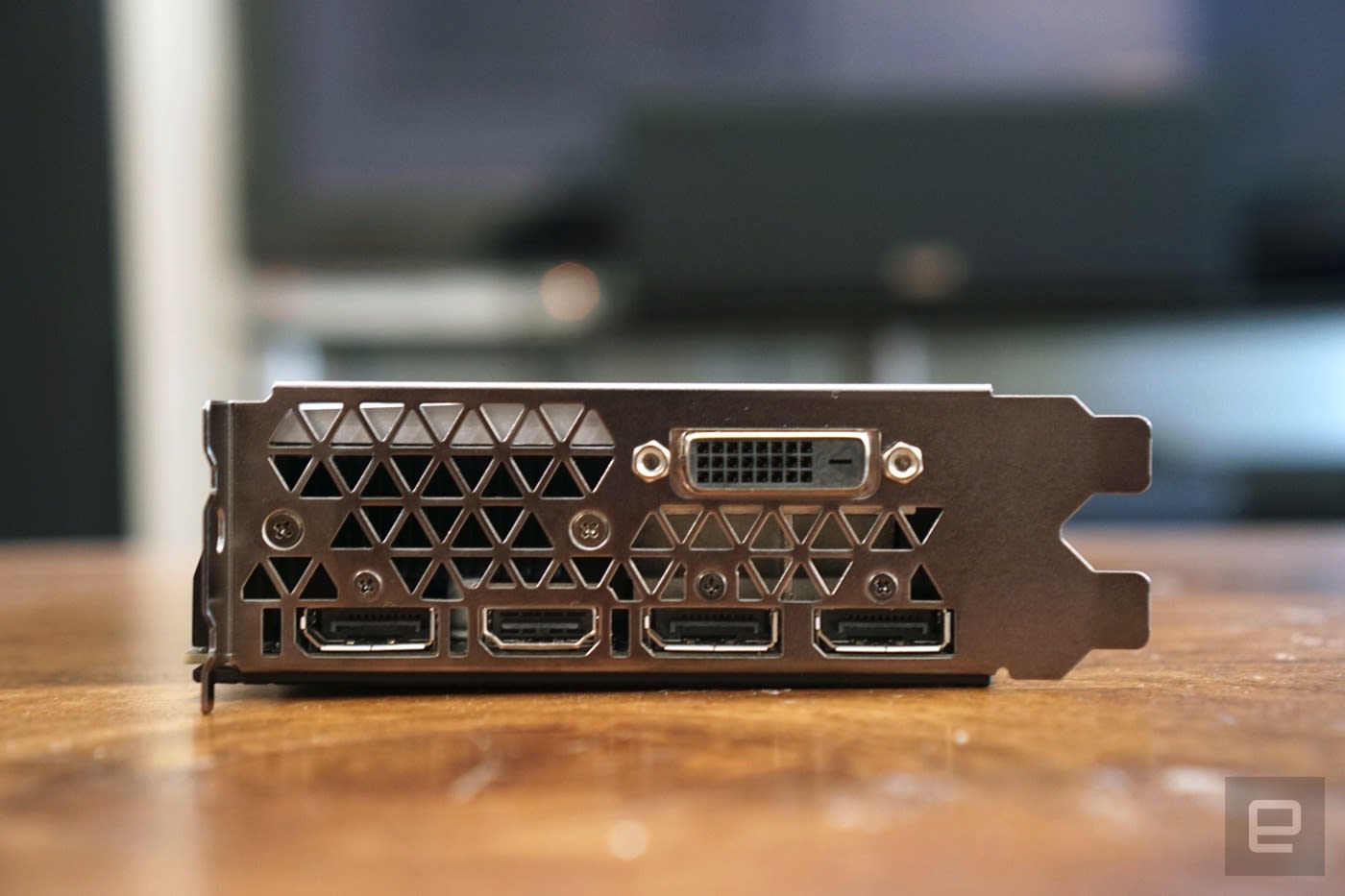
In terms of connectivity, the 1080 Founder's Edition features three DisplayPort connections, one HDMI port and a single DVI socket. Information technology would have been prissy to see some other HDMI port, simply I'one thousand sure there are plenty of professionals out there who are all the same running fancy monitors over DVI.
Setup
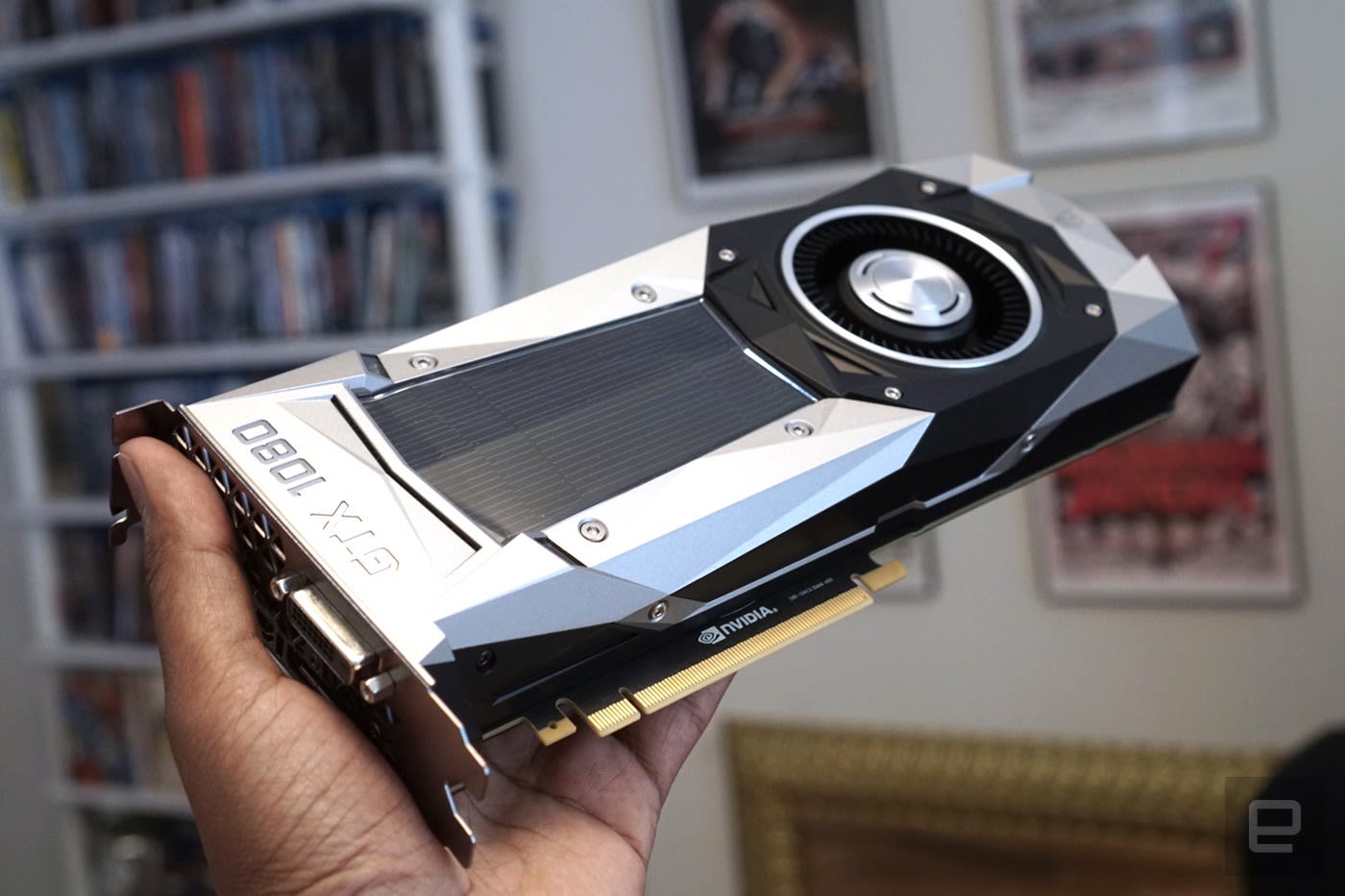
Getting the GTX 1080 up and running isn't any different than with your typical video card. Information technology's a big slice of kit, then yous'll want to make sure in that location's enough room in your case for it to fit, but otherwise it snaps correct into a PCI-East slot and it's powered by a unmarried 8-pin ability connector. Unlike the Radeon R9 Fury X, which required me to movement some case fans around to make room for its water cooler radiator, the GTX 1080 was a cinch to install. Later grabbing some fresh drivers from NVIDIA (and making sure any traces of sometime drivers were gone for practiced), I was off to the benchmarking races.
Performance
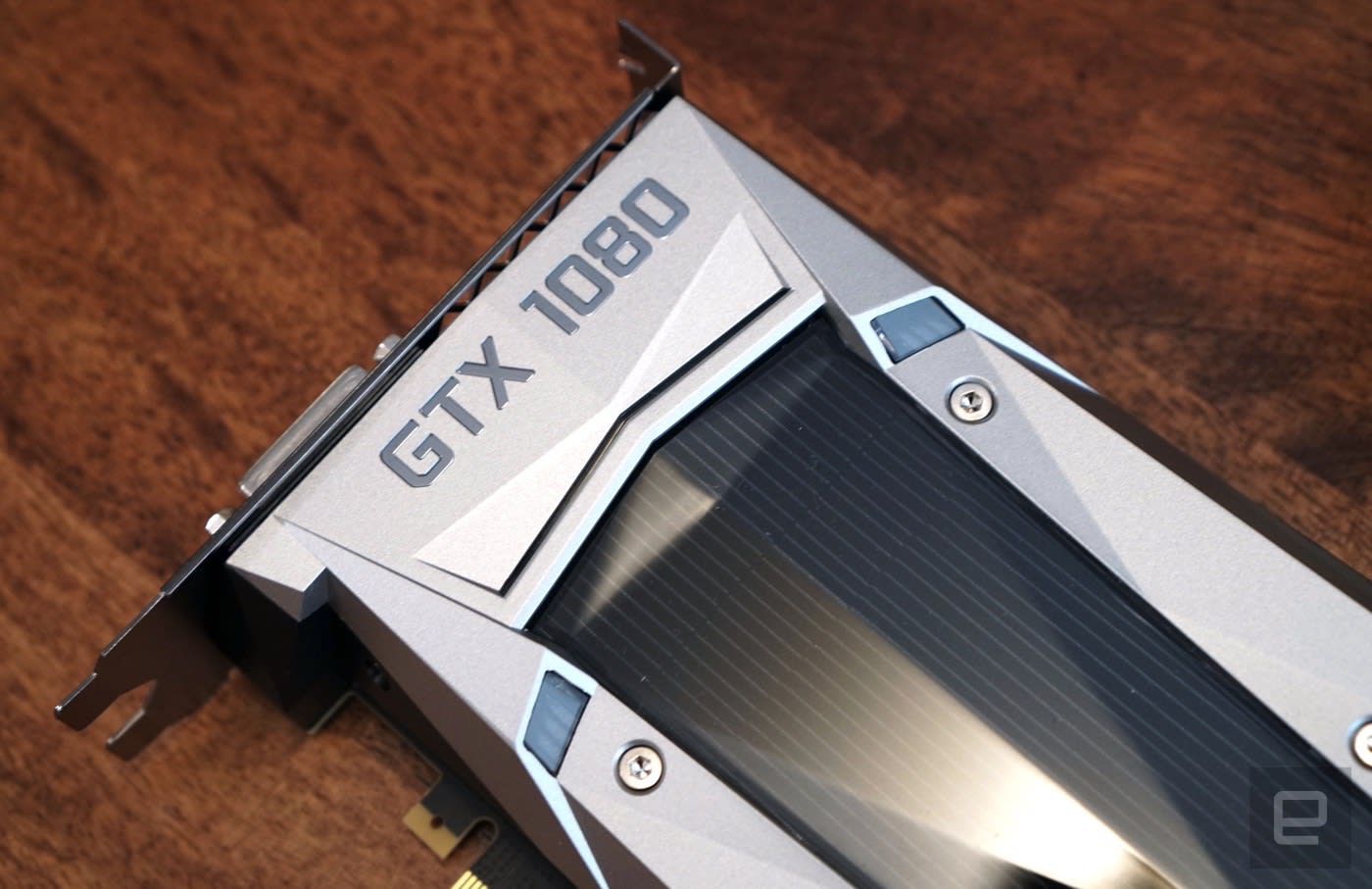
NVIDIA wasn't lying: The GTX 1080 is a beast. I simply had the R9 Fury X to compare it to on my gaming rig (which consists of a 4GHz Core i7-4790K CPU, 16GB of 2400Mz DDR3 RAM and a 512GB Crucial MX100 SSD on a ASUS Z97-A motherboard), but that's a powerhouse GPU that easily keeps pace with the GTX 980 and Titan X. And for every major benchmark, the 1080 was significantly faster.
| 3DMark | 3DMark 11 | |
| NVIDIA GeForce GTX 1080 | Standard 15,859/ Extreme nine,316/ Ultra 5,021 | X9,423 |
| AMD R9 Fury Ten | Standard 13,337/ Extreme 7,249/ Ultra three,899 | 10,6457 |
In 3DMark online comparisons with similar systems, the 1080 was typically ranked meliorate than 92 to 95 percent of results. It was only bested past scores from machines running multiple 980 and 980 Ti cards in SLI fashion (which would also cost a lot more than the 1080 to put together).
| Witcher 3 | Hitman | Fallout 4 | |
| NVIDIA GeForce GTX 1080 | 43 | 48 | 54 |
| AMD R9 Fury X | 35 | 38 | 42 |
Average FPS performance in 4K with all graphics set to maximum
Benchmarks are one affair, but I was more interested in how the GTX 1080 performs in bodily games. And again, information technology didn't disappoint. Compared to the R9 Fury X, it reached around 43 frames per second in the Witcher 3 while running in 4K with all the settings set to Ultra. That made the game much more than playable in such a high resolution: The Fury X averaged effectually 35 fps, and it would sometimes dip below thirty, which makes things unbearably jerky. For Hitman, the 1080 reached a smooth 48 fps on boilerplate, whereas the Fury X hovered around 38.
I was particularly impressed with the menu'due south performance in Fallout 4 (after turning off that game's frame limiter). It was playable on the Fury X, reaching around 42 fps, but on the GTX 1080 it more than often hovered betwixt 50 and 55 fps in most environments. Sometimes information technology would shoot upward of 60 fps indoors, and in wide-open areas it would dip to 40 fps. That wouldn't make for the smoothest feel, but it's certainly a lot more playable in 4K.
Thanks to the elaborate heat sink design, the GTX 1080 Founder's Edition was also cooler than I expected. It idled at a mere 33c, and nether total load it reached between 65c and 70c. I also had no trouble overclocking the GPU past 250MHz (reaching around one.95GHz under load) and the memory by 200MHz without any significant temperature changes. NVIDIA reps managed to push the card past 2.1GHz during a stage demo without whatsoever additional cooling. If you're into overclocking, this card was basically fabricated for you.
Last year I wasn't sold on the viability of 4K gaming -- if a $600 card similar the R9 Fury X couldn't always handle it, why fifty-fifty bother? -- but the GTX 1080 actually makes it feasible with a single card. But while information technology's overnice to see significant progress in high-res gaming, I withal prefer bumping down to a lower resolution like 2,560 x one,440 to ensure a silky 60 fps feel. Most people wouldn't notice the marginal difference in rendering resolution, simply they'd certainly pick out when frames start to stutter in 4K. (Check out this gallery for a look at the below screenshots in full 4K resolution.)
Gallery: GeForce GTX 1080 screenshots | 6 Photos
Gallery: GeForce GTX 1080 screenshots | 6 Photos


Even if yous're not chasing 4K, a powerful card like the 1080 could be used to supersample games, which involves rendering them at a higher resolution than what's existence shown on the screen to remove unsightly jagged lines. It's a technique that'south fallen out of fashion in the PC gaming world, simply at present that cards take calculating ability to spare, it could be a smart way to brand games look even better. With Hitman, I was able to become around lx fps when running it at two,560 ten 1,440 with a 1.2X supersample. I couldn't run across a huge difference without enabling the feature, but this is the sort of thing that some PC gamers might eat up.
When it comes to VR, the GTX 1080 doesn't feel significantly improve than the R9 Fury X. That's partially because the Oculus Rift and HTC Vive run at a relatively low one,200 x 1,080 pixel resolution for each middle display, which is significantly less sharp than the 1080p HD screens we've grown used to. You demand to reach at to the lowest degree 90 fps in VR to make games wait smooth, simply that'due south not a tough target for the 1080 to reach at such a low resolution.
NVIDIA has also included some new applied science, dubbed Simultaneous Multi-Project, that makes the 1080 more efficient at displaying VR scenes than other cards. For instance, it simply needs to render a scene once to testify it in VR, whereas other video cards take to practise that work twice (once for each center). The menu is also much smarter near processing the pixels you really need to see in a scene. These new innovations won't make a big impact on existing VR games, which don't need to be displayed in loftier resolutions, but they could be a big deal with next-generation headsets.
The competition
Equally great as the GTX 1080 is, most gamers will probable opt for its cheaper sibling, the $379 GTX 1070 ($449 for the Founders Edition). Information technology's just slightly slower -- pumping out 6.v teraflops instead of the 1080'south ix teraflops -- just NVIDIA says information technology's also "roughly" the aforementioned performance as the $i,000 Titan X. That's an insane cost-to-functioning ratio, and it likewise leaves room for snapping upwards another (inevitably cheaper) 1070 in a yr or so to bump your speeds upwardly.
Every bit is unremarkably the example, there will also exist enough of competing GTX 1080 designs to choose from in the next few months. Those cards will likely come in closer to the $599 retail cost NVIDIA is advertising rather than the $699 premium for the Founders Edition.
Unremarkably I'd also urge you to expect at previous-generation hardware equally new gear comes in. Merely the 1070 and 1080 are such huge architectural leaps that information technology doesn't brand sense for most people to consider a 970 or 980. If you're really trying to save money, a 970 for around $200 could be a decent deal in the future (they're still going for around $300). But you'd as well regret that choice if y'all want to dabble in VR within the next year.
AMD has also shown off its next-generation graphics applied science, Polaris, which promises to be but every bit power efficient as NVIDIA'south Pascal. We even so don't know what Polaris consumer cards will look similar yet, so information technology might pay off to await a few months earlier you decide on a new GPU.
Wrap-up
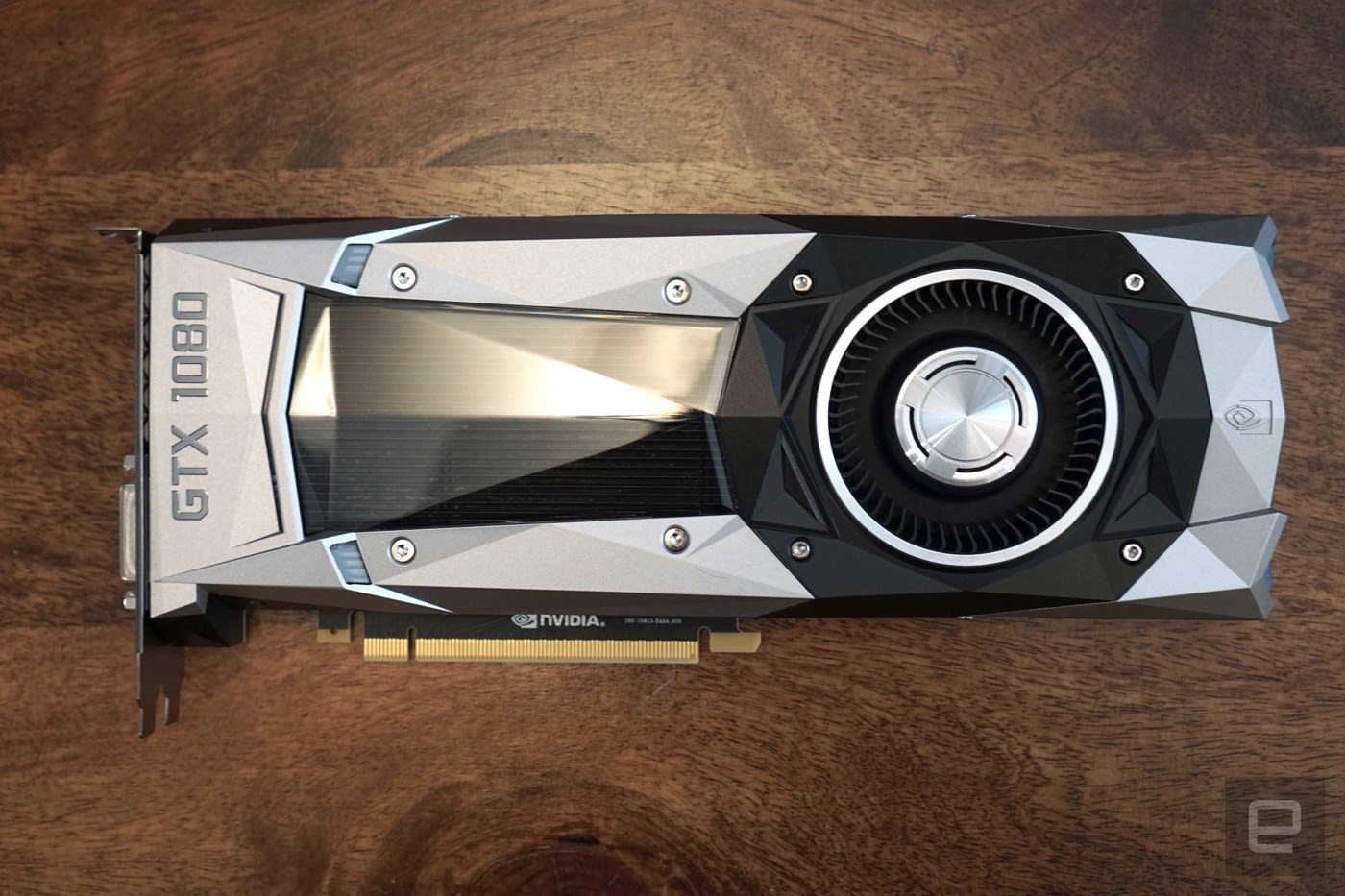
If you accept the cash and need the nigh powerful video card on the market, you can't go wrong with the GTX 1080. It'southward congenital precisely for the things gamers are focused on today: 4K and VR. It's not just an incremental upgrade for NVIDIA: It'southward a dramatic bound forward.
All products recommended by Engadget are selected past our editorial team, independent of our parent company. Some of our stories include chapter links. If you buy something through one of these links, nosotros may earn an affiliate committee.
Source: https://www.engadget.com/2016-05-17-nvidia-geforce-gtx-1080-review.html
Post a Comment for "Nvidiaã‚â® Geforceã‚â® Gtx 1080 With 8gb Gddr5x Graphics Memory Review"